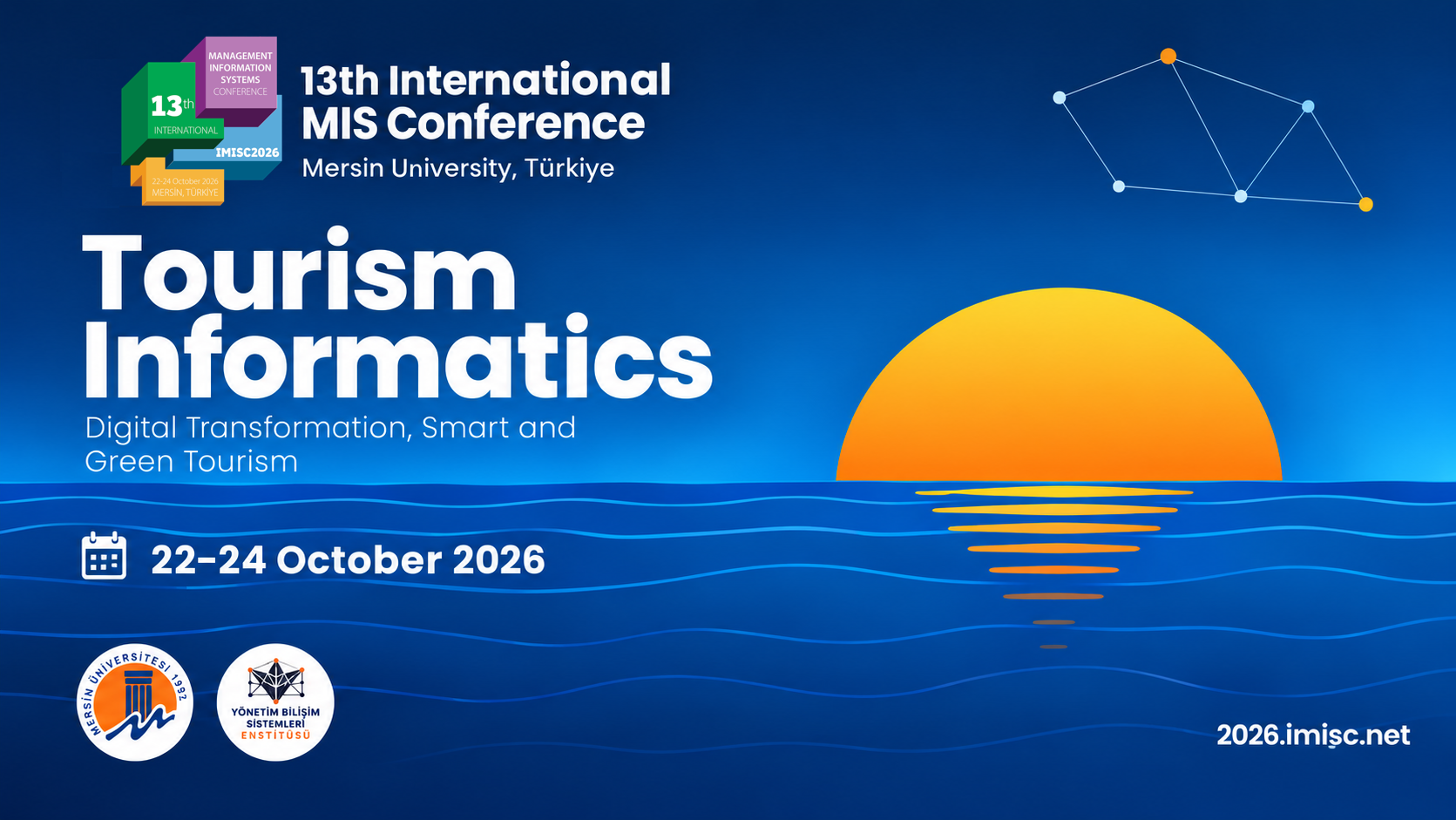
Tourism Informatics
In memory of
Prof. Dr. Haldun AKPINAR
Organized by

The 13th International
Management Information Systems Conference
We are pleased to announce the 13th International Management Information Systems Conference (IMISC 2026), to be held this October at Mersin University, in Mersin, Türkiye, under the auspices of the Institute of Management Information Systems.
This year’s conference will focus on the transformative theme:
Digital Transformation, Smart and Green Tourism
Exploring how digital technologies, data-driven innovations, and intelligent information systems are reshaping tourism ecosystems.
IMISC 2026 aims to foster interdisciplinary dialogue on the strategic role of Management Information Systems in enabling digital infrastructures, sustainable tourism innovation, and environmentally responsible growth within the tourism sector.
We invite original research papers, case studies, and practical insights that contribute to advancing the field of MIS across a broad range of topics related to smart tourism, green information systems, digital transformation, and sustainable tourism development.
The conference will provide a distinguished scholarly environment where academic excellence, applied research, and international collaboration converge within a dynamic Mediterranean setting.
We look forward to your submissions and to welcoming you to IMISC 2026.
IMISC 2026 has applied by TÜBİTAK's 2223-B Grant Program for Organizing Scientific Events within the Country.
Conference Tracks
T - 01
Artificial Intelligence and Applications
Artificial Intelligence and Applications
AI is transforming digital systems by enabling automation and predictive analytics. Contemporary research emphasizes ethics and responsible deployment.
I. Artificial Intelligence in Tourism Informatics
Due to the main theme of the conference being Tourism Informatics, the expected papers will cover topics in the field of Tourism sciences, including:
- AI-powered various data collection techniques
- Machine learning techniques that can be used in decision making
- Robot technologies used or usable during tourism operations
- AI-powered simulation studies for tourism decision support systems
- AI for Tourism
- Applications of AI for Tourism Informatics
- Big Data and IOT for Tourism Informatics
II. Artificial Intelligence in Life Sciences
- AI in personalized medicine
- AI for personalized treatment plans
- AI-powered radiology: From X-rays to MRI interpretation
- AI-assisted pathology
- AI applications in genome sequencing and personalized medicine
- Predicting genetic disorders using machine learning models
Core Technologies
- Machine & Deep Learning
- Natural Language Processing
- Generative AI & LLMs
- Explainable AI
T - 02
Internet of Things and Industry 5.0
Internet of Things and Industry 5.0
Industry 5.0 represents the next phase in the evolution of the industrial sector, building upon the technological advancements of Industry 4.0 but shifting the focus towards a more humancentric approach.
IoT is transforming everyday life and opening up new opportunities for innovation across numerous industries, making it a fundamental element of the digital transformation era.
Topics of interest include but not limited to:
- Advancements in IoT Technologies
- IoT in Smart Manufacturing
- Cybersecurity Challenges and Solutions
- Human-Centric Approaches in Industry 5.0
- Sustainability and IoT
- Emerging Trends in IoT and Industry 5.0
- IoT Applications Across Industries
- Innovations in IoT Technology
T - 03
Medical Tourism Informatics
Medical Tourism Informatics
Medical tourism is a multi-stakeholder activity with economic, technological, cultural, social, and legal dimensions that are not limited to healthcare institutions. It requires effective inter-institutional coordination and its market is growing day by day.
Advances in information and communication technologies (ICT) in medical tourism facilitate access to quality healthcare services. At the same time, the integration of ICT with medical tourism ensures the continuity of treatment and follow-up for patients returning to their home countries after receiving healthcare services.
The determinants of quality service delivery in medical tourism are socio-cultural, financial, and legal guarantees supported by a scientific and technological infrastructure.
T - 04
Digital Government / e-Government e-Business e-Commerce
Digital Government / e-Government e-Business e-Commerce
Focuses on alignment of technological innovation with environmental responsibility and effective governance.
- Green Information Systems
- Data-driven policy
- Smart governance models
- Circular digital economy
T - 05
Cybersecurity and Resilience in the Digital Age
Cybersecurity and Resilience in the Digital Age
Secure architectures and privacy frameworks are essential for trust in interconnected environments.
- Secure infrastructures
- Data privacy compliance
- Risk management strategies
- Secure AI deployment
T - 06
Digital Transformation: Strategies and Technologies
Digital Transformation: Strategies and Technologies
Reshapes organizational structures and value creation through strategic technology integration.
- Digital strategy
- Innovation management
- Blockchain & Distributed systems
- Digital maturity assessment
T - 07
Social Media Analytics and Intelligence Research & Theory (SMART)
Social Media Analytics and Intelligence Research & Theory (SMART)
Transforms unstructured social data into actionable intelligence for forecasting and planning.
- Sentiment mining
- Demand forecasting
- Social network analysis
- Behavioral modeling
T - 08
Human–AI Interaction and Collaboration
Human–AI Interaction and Collaboration
As AI systems become embedded in decision-making, work, and daily life, the key challenge is no longer just building them—but making them usable, trustworthy, and aligned with human needs. This sits perfectly within MIS, which bridges technology and human/organizational behavior.
Possible subtopics:
- Human–AI collaboration in workplaces
- Trust, reliance, and overreliance on AI systems
- Explainable AI (XAI) and user understanding
- UX/UI design for AI-driven systems
- Human-in-the-loop and augmented decision-making
- Behavioral impacts of AI recommendations
- Cognitive load and interaction design with AI
- Ethics and user perception of AI systems
- Conversational agents, chatbots, and virtual assistants
- AI literacy and user adaptation
T - 09
General Topics in MIS
General Topics in MIS
Research contributing to the design, governance, and strategic use of information systems across various domains.
- IS architecture and integration
- Decision support systems
- Emerging technologies and implementation
- Societal and organizational impacts of IT
Keynote Speakers

Deputy Director of the International Centre for Tourism and Hospitality Research


(Association for Information Systems) (www.aisnet.org)
Invited Speakers
Partners


Venue
Uğur Oral Kültür Merkezi
Mersin Üniversitesi
Çiftlikköy Kampüsü
Yenişehir / Mersin
and Contact

Institution
YBS Enstitüsü

Website
2026.imisc.net

Email Us
vtecim@gmail.com
In memory of